

Ecological and Environmental Foundations of Native Landscapes
Sustainable landscapes are not created by accident—they are built through thoughtful plant selection, responsible water management, and an understanding of the local environment. One of the most effective ways to create a landscape that thrives for decades is by incorporating native plants. These species have evolved naturally in a specific region over thousands of years, meaning they are uniquely adapted to the local climate, soil conditions, rainfall patterns, and seasonal temperature changes. Because of this natural compatibility, native plants typically require less irrigation, fewer chemical inputs, and significantly less ongoing maintenance than non-native species.
The role of native plants in long-term landscape sustainability goes far beyond simple aesthetics. Native plant communities support local wildlife, promote healthier soil systems, and help landscapes remain resilient during droughts, storms, and other environmental stresses. By designing landscapes that work with nature rather than against it, property owners and landscape professionals can create outdoor environments that remain vibrant, functional, and environmentally responsible for years to come.
Here’s a quick overview of why native plants matter for sustainable landscapes:
| Benefit | Native Plants | Conventional Turf Grass |
|---|---|---|
| Installation cost (per acre) | $3,400–$5,975 | $7,800–$14,825 |
| 10-year maintenance cost (per acre) | $1,600–$1,788 | $5,550–$6,471 |
| Water use (half-acre, summer) | Minimal irrigation needed | Up to 162,924 gallons |
| Wildlife support | Hundreds of species | Very few |
| Soil health | Deep roots, strong structure | Shallow, chemically dependent |
Over the past century, urban sprawl has consumed more than 150 million acres of natural habitat across the continental U.S. Much of that land was replaced by manicured lawns — which now cover over 40 million acres nationwide. These conventional landscapes look tidy, but they come at a steep ecological and financial cost.
Native plants — species that evolved naturally in a specific region before European settlement — work with local soils, rainfall patterns, and wildlife. Exotic ornamental species, by contrast, were introduced from other parts of the world and often lack the deep ecological relationships that make landscapes truly self-sustaining.
The difference isn’t just environmental. It’s economic. It’s practical. And for property managers and owners responsible for large, complex grounds, it’s a decision that compounds in value year after year.
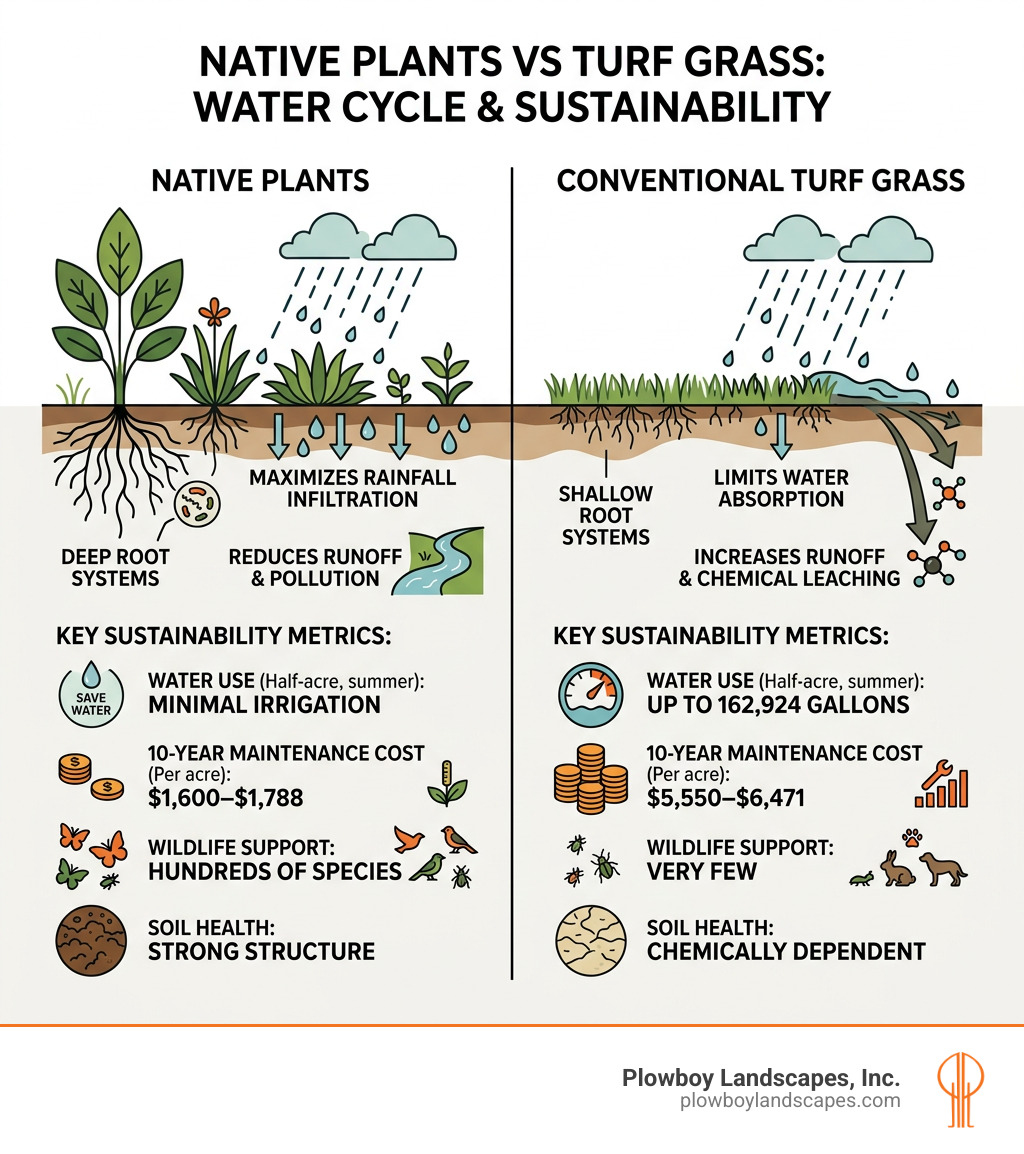
When we talk about eco-friendly landscaping, we are essentially talking about rebuilding the biological foundation of our properties. Native plants are the cornerstone of this foundation. Unlike exotic species, which are often “ecological dead ends,” native plants have co-evolved with local fauna for millennia.
Supporting the Food Web and Biodiversity
One of the most striking pieces of scientific research on native plant biodiversity highlights how native species outperform exotics in supporting local life. For example, a single native oak tree can support over 500 species of caterpillars. In contrast, the exotic Ginkgo tree, while popular in urban design, hosts only five.
Why does this matter to a property owner in Santa Barbara or Ventura? Because caterpillars are the primary food source for birds. It takes over 6,000 caterpillars to raise just one brood of chickadees. By choosing native plants, we aren’t just planting a garden; we are fueling a local food web. Research in Southern California has specifically shown that native perennials attract significantly greater native pollinator abundance and diversity than non-native ornamentals.
Water Conservation and Soil Health
In our region, water is our most precious resource. Standard turf grass is an incredibly thirsty beast. Watering a half-acre turf lawn for just 12 summer weeks can require a staggering 162,924 gallons of water. Native plants, once established, require minimal irrigation because they are adapted to our Mediterranean climate.
Beyond saving water, native plants are soil builders. They possess deep root systems — sometimes reaching 10 to 15 feet underground — that improve soil aeration and structure. This is a key finding in USDA Urban Soil Sequestration Research, which notes that healthy soils have the potential to sequester up to 24% of total emissions from fossil fuel combustion. By increasing organic matter and root biomass, native landscapes turn your property into a carbon sink.
Stormwater, Erosion, and Air Quality
Native landscapes act as a natural sponge. Their deep roots anchor the soil, preventing the erosion that often plagues coastal estates. They also facilitate stormwater management by allowing rain to infiltrate the ground rather than running off into drains.
Furthermore, native landscaping improves air quality. Conventional lawn maintenance is a major source of Biogenic Volatile Organic Compounds (VOCs) and emissions. By reducing the need for gas-powered mowers and blowers — which are being phased out in California — we significantly lower the landscape’s carbon footprint.
The Economic Case for The Role of Native Plants in Long-Term Landscape Sustainability
Many property managers assume that “going native” is an expensive environmental luxury. The data suggests the exact opposite. While the initial planning and plant selection may require a thoughtful investment, the long-term savings are undeniable.
| Expense Category | Conventional Turf (10-Year Avg) | Native Landscape (10-Year Avg) |
|---|---|---|
| Installation | $7,800–$14,825 per acre | $3,400–$5,975 per acre |
| Maintenance | $5,550–$6,471 per acre | $1,600–$1,788 per acre |
| Fertilizer/Pesticides | High | Minimal to None |
| Water Bills | Significant | Low to None |
Native landscapes can cost up to three times less than traditional turf grass over a ten-year period. This is largely due to the reduction in “inputs.” Once a native meadow or shrubland is established, it doesn’t need weekly mowing, seasonal fertilization, or constant chemical intervention to look its best.
For commercial facilities, these savings scale beautifully. Large estates and corporate campuses that transition to native vegetation often see their maintenance budgets drop by 56% or more. For those looking for resources, the EPA Homeowner Resources for Native Landscaping provides excellent toolkits for understanding these transitions.
At Plowboy Landscapes, we emphasize water management strategies for commercial landscapes that prioritize native selections. It’s not just about being “green”; it’s about fiscal responsibility and property value preservation.
Design Strategies and The Role of Native Plants in Long-Term Landscape Sustainability
A common hurdle in native landscaping is public perception. Some people hear “native” and think “weedy” or “untidy.” This is where intentional design comes into play. By applying the principles of biophilic design — which focuses on the human connection to nature — we can create native spaces that are both ecologically functional and aesthetically stunning.
Cues to Care
To ensure acceptance in suburban and commercial settings, we use what researchers call “cues to care.” This involves framing native areas with traditional landscape elements. Examples include:
- Crisp, mown borders around native meadows.
- Clearly defined paths and walkways.
- Intentional groupings of plants rather than a random mix.
- Using pollinator-friendly planting for large estates to create vibrant focal points.
Urban Integration and The Role of Native Plants in Long-Term Landscape Sustainability
Integrating natives into urban environments requires a careful site assessment. We look at sun exposure, drainage, and soil composition. For commercial scaling, we often recommend “keystone” genera — plants like native oaks, sages, and buckwheats — that provide the most “bang for the buck” in terms of wildlife support and resilience.
For high-profile locations, we might look to projects like the Santa Barbara Zoo native Australian habitat for inspiration on how to blend educational value with high-end landscape construction.
Frequently Asked Questions about Native Landscaping
Landscaping with native plants often raises important questions for property owners who want to balance beauty, functionality, and environmental responsibility. While the concept of sustainability in landscaping is becoming more widely understood, many people still want to know how native plants perform in everyday settings, how much maintenance they require, and whether they can truly deliver long-term benefits. The following frequently asked questions help clarify the role native plants play in building resilient, sustainable landscapes and what you can expect when incorporating them into your outdoor spaces.
How do native plants differ from exotic species in maintenance?
Native plants generally require more “proactive” maintenance during the first two years (the establishment phase) and far less “reactive” maintenance thereafter. While exotic species often need constant feeding and watering to survive in our dry climate, established natives primarily need seasonal pruning and light weeding.
Can native plants be used in formal landscape designs?
Absolutely. Many native species, such as Prunus ilicifolia (Hollyleaf Cherry) or Baccharis pilularis (Pigeon Point Coyote Brush), can be pruned into formal hedges or structured groundcovers. The key is selecting species with “tame” growth habits and using them within a structured design framework.
What are the best native plants for carbon sequestration?
Long-lived woody plants and deep-rooted perennials are the champions of carbon storage. In Southern California, our native Oaks (Quercus species) and Sycamores (Platanus racemosa) are top performers. Additionally, native bunchgrasses are excellent at pumping carbon deep into the soil through their extensive root networks.
Plowboy Landscapes: Your Partner in Beautiful, Sustainable Outdoor Spaces
If you’re ready to transition your large property to eco-friendly landscaping—or want a more reliable maintenance partner—Plowboy Landscapes is here to help.
For 55 years, we’ve specialized in maintaining large-scale properties across Santa Barbara, Ventura County, the Central Coast, and the San Fernando Valley. Our dedicated full-time gardeners, decades of expertise, and commitment to environmental integrity set us apart from standard maintenance crews.
Whether you want to improve water efficiency, overhaul outdated landscaping, or create a more sustainable long-term plan, we bring the skill and consistency needed to maintain large properties the right way.
Call us today: (805) 643-4966
Email any questions to: office@powboylandscapes.com